
Nanning East Station – Large‑Span Prestressed Concrete Roof Structure
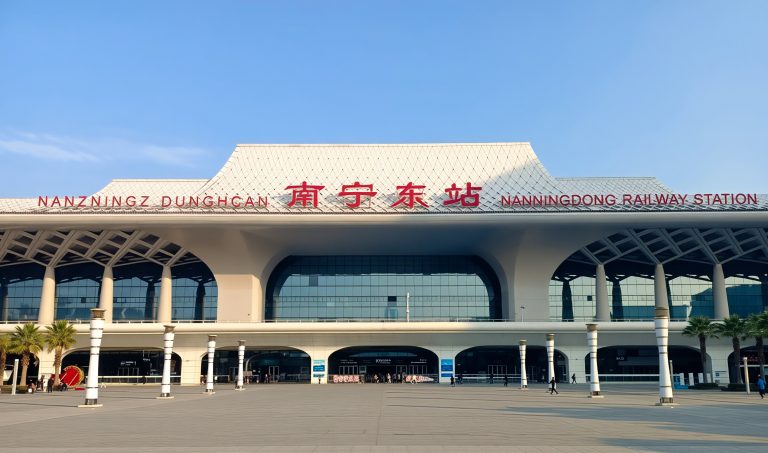
Nanning East Railway Station is a major transportation hub in Guangxi, China, serving high‑speed rail, intercity trains, and urban transit. The station features a large‑span prestressed concrete roof structure with a maximum span of 66 m, using a beam‑slab system with post‑tensioned beams. The total construction area exceeds 250,000 m², and the roof structure was designed to achieve long spans with reduced material consumption while maintaining high durability and seismic resistance.
Prestressing technology was extensively applied in the main hall beams, transfer girders, and foundation slabs to control deflection, eliminate cracking, and optimize structural thickness.
🛠️ Construction Challenges & Prestressed Solutions
| Construction Challenge | Description | Prestressed Solution |
|---|---|---|
| Ultra‑long span roof beams Main span up to 66 m | Conventional reinforced concrete would require excessive beam depth (3.5 m), increasing weight and reducing clearance. | Use bonded post‑tensioning with multi‑strand tendons (1860 MPa); parabolic tendon profiles balance dead and live loads, reducing beam depth to 2.2 m (‑35%). |
| Restricted construction time Fast‑track schedule | Multiple trades working simultaneously, traditional cast‑in‑place secondary beams slow down the critical path. | Adopt precast prestressed double‑T units for secondary beams and parking decks; prefabrication parallel to substructure work, accelerating schedule by 25%. |
| High shrinkage & temperature cracking Massive concrete slabs (1.5 m thick) | Hydration heat and shrinkage cause high tensile stresses, leading to early‑age cracking. | Incorporate unbonded post‑tensioning tendons in roof and foundation slabs; impose pre‑compression to offset tensile stresses from shrinkage and temperature changes. |
| Clash with MEP systems Dense mechanical/electrical/plumbing ducts | MEP ducts conflict with conventional reinforcement, requiring thick slabs and complex coordination. | Use flat post‑tensioning slabs with unbonded strands; tendons placed around MEP openings, reducing beam depth and simplifying coordination. |
| Long‑term deflection control Excessive creep & shrinkage | Creep and shrinkage may cause progressive deflection, affecting track alignment and passenger comfort. | Specify low‑relaxation strands (≤2.5% at 1000 h); apply staged tensioning; monitor deflection during service. |
| Corrosion protection Aggressive environment (de‑icing salts, humidity) | Strand corrosion compromises durability, especially near access roads and underground areas. | Use epoxy‑coated strands or fully grouted bonded tendons with corrosion‑inhibited grout; ensure complete encapsulation for 100‑year design life. |
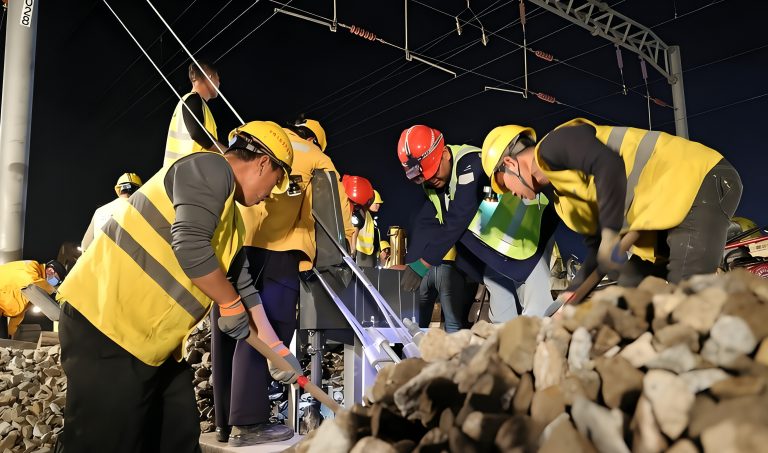
Prestressed solutions applied to main hall beams, transfer girders, and foundation slabs
✅ Achievements & Summary
Through the application of advanced post‑tensioning technology:
· Achieved 66 m clear span with beam depth reduced from 3.5 m (conventional) to 2.2 m, saving 30% concrete volume.
· Zero cracking observed in the main hall roof and transfer beams.
· Reduced on‑site construction time by 25% using precast prestressed double‑T units.
· Fully compliant with Chinese high‑speed railway station design codes.
Nanning East Station demonstrates how modern prestressed solutions enable large‑span public transportation hubs to be built efficiently, economically, and durably, serving as a benchmark for future railway stations across China.
Liuzhou Xuanqiao
A-10-4, Hebiao Industrial Park, Yufeng District, Liuzhou, Guangxi, China
Email: andy@lzxqv.com
