
Innovation Bridge of QishanhuSci-Tech and Innovation Valley, Jiangsu
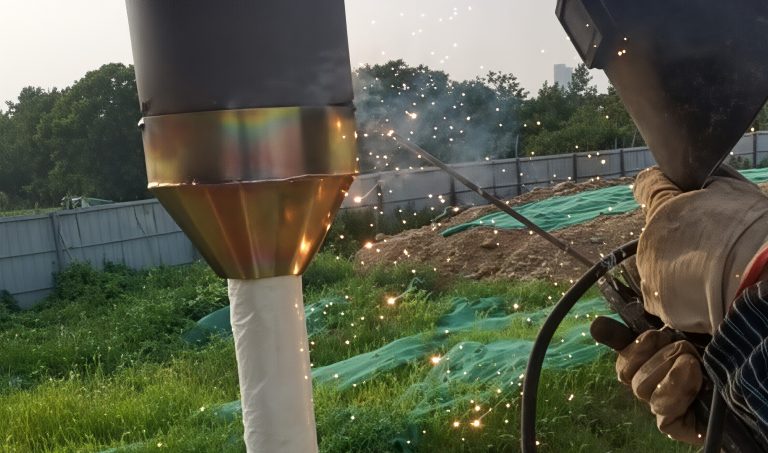
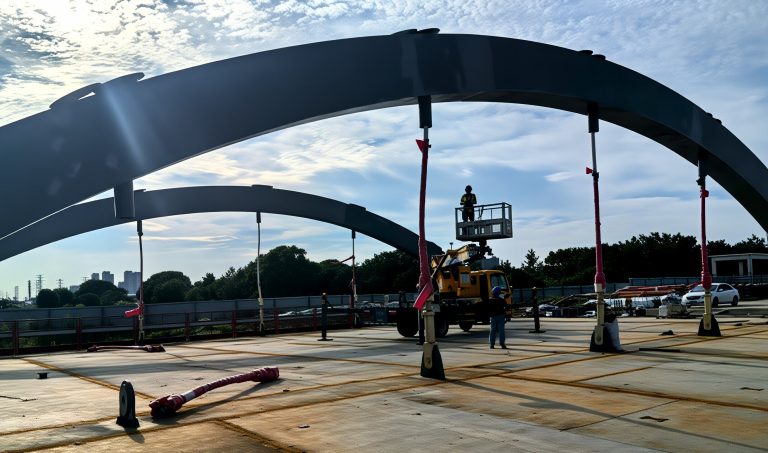
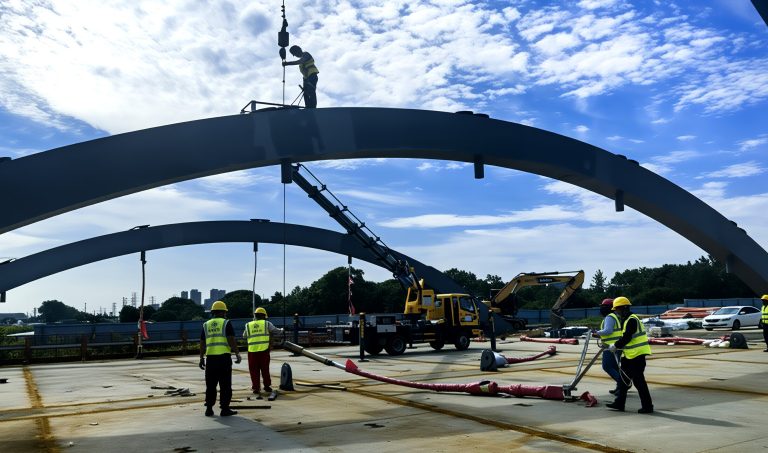
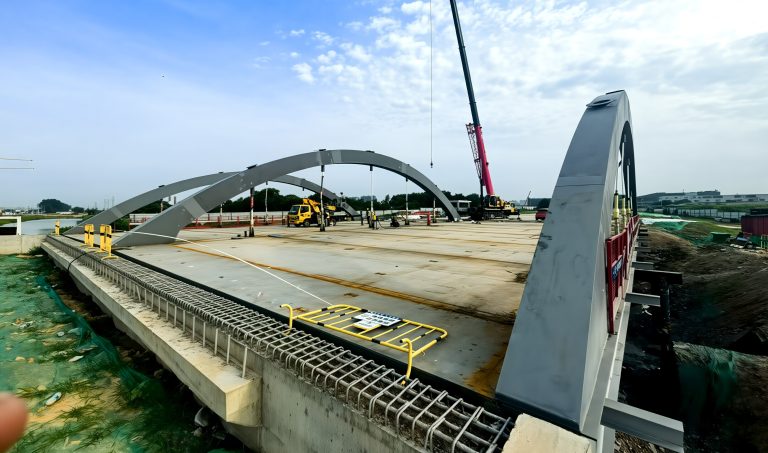
The Qishan Lake Science and Innovation Valley is a key sci‑tech hub in Jiangyin, Jiangsu Province. Within the Phase‑1 road network, four major roads (Innovation Road, Chuangxiang Road, Chuangzhi Road and Lanxiu Road) are under construction, forming three vertical and one horizontal arteries that will define the valley’s basic traffic framework.
Among them, Innovation Road runs from Chuangxiang Road in the north to Huanshan Road in the south, with a total length of 1,023 m. It includes a 31‑meter long river‑crossing bridge – a steel‑box tied‑arch bridge. Tied‑arch bridges rely on prestressed tie members to balance the horizontal thrust generated by the arch ribs, creating a self‑equilibrated system that allows conventional bridge substructures to be used without heavy thrust resistance.
🛠️ Prestressed System Application
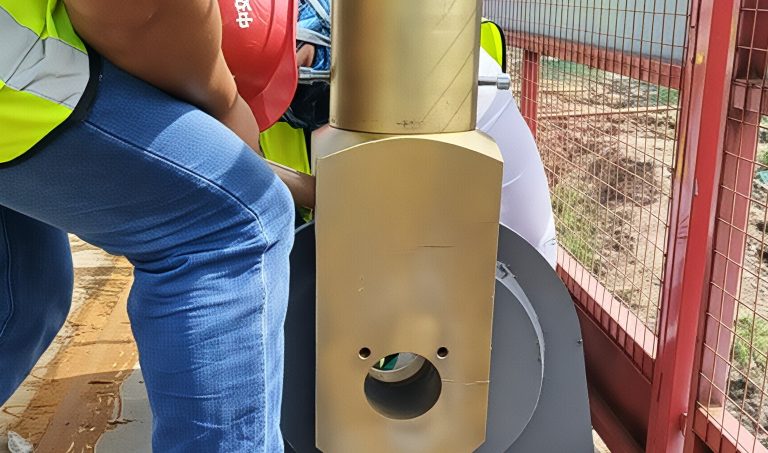
The prestressed works of the Innovation Road Bridge mainly focus on the tie rods inside the steel‑box girder:
· Prestressed steel strand: high‑strength, low‑relaxation strands (typical 1860 MPa) provide the tensile capacity required by the ties.
· Anchorage assembly (wedges, anchor plates): permanently lock the prestressing force at the tendon ends, ensuring long‑term load retention.
· Post‑tensioning jack & hydraulic oil pump: tension the strands to the design force with digital elongation monitoring.
· Corrugated metal duct: form the void for the strands inside the concrete/steel members; precision placement avoids friction loss.
· Grouting pump & material: fill the ducts after tensioning, bonding the strands to the structure and providing corrosion protection.
By controlling the tensioning force of the prestressed ties, the horizontal thrust at the arch springing can be reduced by up to 42%. This makes the substructure behave like a simple continuous beam, particularly suitable for areas with soft subgrade.
| Construction Challenge | Description | Prestressed Solution |
|---|---|---|
| High tendon friction in curved ducts Curved steel‑box arch geometry |
The steel‑box tied‑arch bridge features complex curvature, causing high friction when pulling strands through ducts. Strands may kink or fail to pass through. | Use dedicated strand pusher/puller with lubricant; pre‑assemble strand bundles; optimise duct alignment and reduce sharp bends. |
| Uneven tensioning of multiple strands Asynchronous force distribution |
Multiple strands may show different elongations, leading to unbalanced prestress and structural distortion. | Deploy synchronous multi‑jack tensioning system with digital control; monitor each strand’s elongation individually and adjust oil pressure in real time. |
| Grouting voids & corrosion risk Incomplete duct filling |
Air trapped in ducts or improper grout mix produces voids, reducing bond and causing long‑term strand corrosion. | Apply vacuum‑assisted grouting (vacuum pump + high‑quality grout); perform post‑grouting inspection (impact echo or X‑ray). |
| Anchor zone cracking Concrete spalling near anchor head |
High local bursting stress under the anchor plate may cause cracking or even failure. | Install spiral reinforcement or supplementary mesh; increase bearing plate area; apply staged tensioning to reduce peak stress. |
| Jack calibration & safety Inaccurate prestressing force |
Uncalibrated jacks or pressure gauges lead to under‑tensioning or over‑tensioning. | Calibrate jacks and gauges every 200 pulls or monthly; use digital readout with real‑time force/elongation curve; keep calibration certificates. |
| Tendon relaxation loss Long‑term prestress reduction |
Strand relaxation over time reduces effective prestress, affecting serviceability. | Specify low‑relaxation strands (≤2.5% at 1000 h); design with appropriate safety margin; re‑tension if possible. |
Prestressed system successfully balanced arch thrust, reduced horizontal load by 42%, and eliminated heavy abutments.
✅ Achievements & Summary
Through the application of advanced post‑tensioning technology:
· Achieved a tied‑arch self‑equilibrated structure, eliminating heavy abutments.
· Improved installation efficiency by 25% and reduced high‑altitude operations by 80% using prefabricated segment assembly.
· Fully compliant with ISO 9001 and Chinese railway standards (TB/T 3193‑2016).
The Innovation Road Bridge demonstrates how modern prestressing solutions turn aesthetic arch designs into safe, durable and cost‑efficient infrastructure, supporting the rapid development of the Qishan Lake Science and Innovation Valley.
Liuzhou Xuanqiao
A-10-4, Hebiao Industrial Park, Yufeng District, Liuzhou, Guangxi, China
Email: andy@lzxqv.com
