
SanJiang Yiyang Fengyu Bridge (Covered Bridge) – Prestressed Concrete Arch Structure
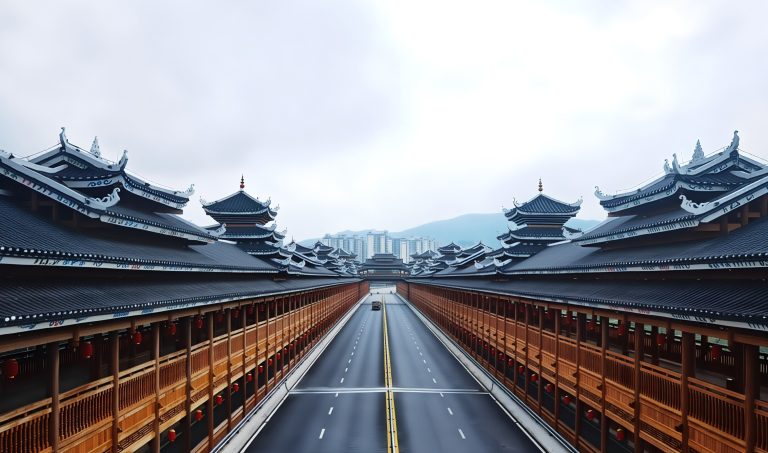
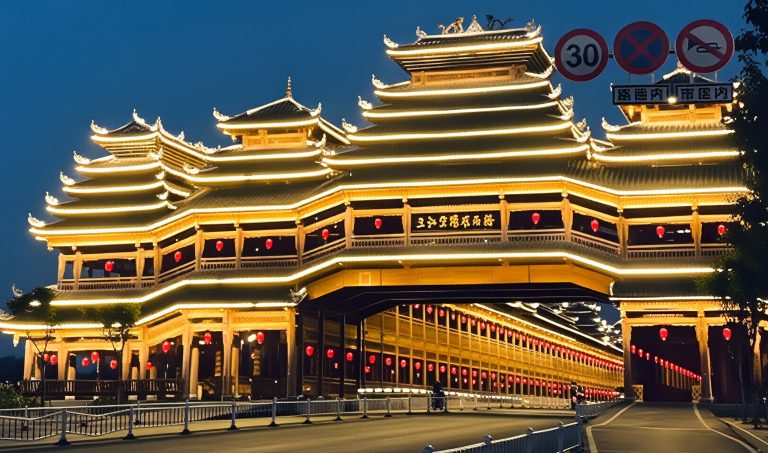
Sanjiang Yiyang Fengyu Bridge, located in Sanjiang Dong Autonomous County, Guangxi, China, is a unique timber‑concrete hybrid covered bridge (Fengyu Bridge). The main structure consists of a prestressed concrete arch with a clear span of 98 m, carrying a heavy wooden pavilion superstructure that integrates traditional Dong ethnic architecture with modern engineering. The total length of the bridge is 368 m, and it serves as a vital pedestrian and light vehicle crossing over the Xunjiang River.
Prestressing technology was applied in the concrete arch ribs, piers, and deck system to control deformation under the asymmetric dead load of the timber pavilions, to resist seismic forces in the mountainous region, and to ensure long‑term durability in a humid river environment.
🛠️ Construction Challenges & Prestressed Solutions
| Construction Challenge | Description | Prestressed Solution |
|---|---|---|
| Unique timber‑concrete hybrid structure Heavy wooden pavilions on concrete arch | The upper wooden structure exerts significant vertical load; differential deformation between timber and concrete may cause cracking. | Apply bonded post‑tensioning in the concrete arch ribs; design tendon profile to counteract the heavy dead load from timber pavilions, ensuring uniform settlement. |
| High seismic demand in mountainous region Active fault zone nearby | Sanjiang area is seismically active; the heavy superstructure increases seismic inertia forces | Incorporate vertical prestressing bars in the arch piers; use energy‑dissipating prestressed anchor cables to improve ductility and self‑centering capacity. |
| Long‑span arch construction over river Main span ~100 m without temporary supports | Building arch ribs over a deep river with limited falsework access. | Adopt segmental precast post‑tensioned arch ribs; erect using cable‑stayed cranes; tension tendons sequentially to achieve arch closure without mid‑span falsework. |
| Corrosion protection in humid river environment High humidity & seasonal flooding | Constant moisture exposure increases strand and anchor corrosion risk. | Use epoxy‑coated strands or fully grouted bonded tendons with corrosion‑inhibited grout; apply additional waterproofing layers at anchor heads. |
| Preservation of traditional timber architecture No visible steel or concrete elements in upper structure | The covered bridge must maintain its traditional wooden appearance, hiding all prestressing components. | Conceal prestressing anchorage zones inside concrete arch ribs and pier caps; use unbonded tendons to avoid grouting aesthetics issues. |
| Complex tendon layout due to arch curvature Variable radius & horizontal curve | The arch rib follows a curved alignment, making duct installation and strand threading difficult. | Pre‑bend ducts in factory; use strand puller with lubricant; pre‑assemble strand bundles to reduce field friction and ensure accurate placement. |
Achieved seamless hybrid behaviour, seismic resilience, 100‑year durability, and preserved traditional wood aesthetics
✅ Achievements & Summary
Through the application of advanced prestressing technology, the bridge successfully achieves a seamless integration of heavy timber pavilions with a concrete arch structure.
· Structural integrity – Bonded post‑tensioning in the arch ribs controls differential deformation and prevents cracking under the asymmetrical dead load of the wooden superstructure.
· Seismic resilience – Vertical prestressing bars and energy‑dissipating anchor cables enhance ductility and self‑centering capacity in an active fault zone.
· Durability – Epoxy‑coated strands and fully grouted bonded tendons with corrosion‑inhibited grout provide 100‑year protection in a humid river environment.
· Cultural authenticity – All prestressing components are hidden inside concrete elements, preserving the traditional wooden appearance of the covered bridge.
The Sanjiang Yiyang Fengyu Bridge demonstrates that modern prestressing technology can be harmoniously integrated with ethnic architectural heritage, delivering safety, longevity, and aesthetic authenticity
Liuzhou Xuanqiao
A-10-4, Hebiao Industrial Park, Yufeng District, Liuzhou, Guangxi, China
Email: andy@lzxqv.com
