
Frequently Asked Questions
Quick answers to the most common questions about our prestressing equipment, product selection, installation, maintenance, and after-sales support. If you don’t find what you’re looking for, feel free to contact us directly.
It depends on the number of strands and the required tension force. Our YCWB series ranges from 100T to 300T (1000kN–3000kN). We also offer custom solutions for larger or smaller requirements.
Quick reference:
Quick reference:
- YCWB100 – 1000 kN (≈100T) | 200mm stroke | 70 kg
- YCWB200 – 2000 kN (≈200T) | 200mm stroke | 120 kg
- YCWB300 – 3000 kN (≈300T) | 200mm stroke | 180 kg
The YCWB series is our 4th generation lightweight design — smaller, lighter, and more durable than the YCW series. It offers better sealing performance, higher strength reliability, and lower maintenance costs while maintaining the same rated capacity.
In short: YCWB = upgraded, lighter, more cost-efficient over the long run.
In short: YCWB = upgraded, lighter, more cost-efficient over the long run.
Our standard stroke length is 200mm for all YCWB series models.
Custom stroke options are available upon request for specific project requirements. Please contact us with your specifications.
Custom stroke options are available upon request for specific project requirements. Please contact us with your specifications.
Our anchor wedges (夹片) are manufactured through a precision 10-step process to ensure reliable gripping performance and long-term durability under high tension loads.
Production process (step-by-step):
Production process (step-by-step):
- 1. Cold drawing – Wire rod is drawn to precise diameter, improving dimensional accuracy and surface finish.
- 2. Intermediate annealing – Heat treatment to relieve internal stress and restore ductility for further forming.
- 3. Pickling – Acid bath to remove surface oxides and scale, preparing for coating.
- 4. Phosphating – Phosphate coating applied to improve lubrication and corrosion resistance.
- 5. Saponification – Soap-based lubricant coating to reduce friction during cold heading and extend tool life.
- 6. Cutting – Wire is cut to precise blank length for the wedge.
- 7. Cold heading – The blank is cold-formed into the basic wedge shape at room temperature for high strength and precision.
-
8. Heat treatment (3-stage process) – Through-hardening to achieve the required hardness, strength, and wear resistance:
- • Carburizing – Surface carbon enrichment to increase case hardness and fatigue resistance while maintaining a tough core.
- • Quenching – Rapid cooling to lock in the hardened microstructure, achieving high surface hardness and wear resistance.
- • Tempering – Controlled reheating to relieve internal stress, adjust hardness/toughness balance, and reduce brittleness.
- 9. AOI (Automated Optical Inspection) – Machine vision inspection to detect surface defects and dimensional deviations automatically.
- 10. Packing – Final packaging with anti-rust protection, ready for shipment.
💡 Quality assurance: Every batch is traceable. Our AOI system ensures 100% inspection of critical dimensions and surface quality.
Our standard jacks are made of high-strength alloy steel — cost-effective, durable, and proven for heavy-duty site conditions.
We also offer aluminum alloy versions, which are significantly lighter (ideal for frequent handling or lifting-limited sites) but at a higher cost.
We can advise which option suits your project better based on your site conditions and budget.
We also offer aluminum alloy versions, which are significantly lighter (ideal for frequent handling or lifting-limited sites) but at a higher cost.
We can advise which option suits your project better based on your site conditions and budget.
Our products comply with multiple international and industry standards, including:
- GB/T14370‑2015 – Chinese national standard for prestressing anchors
- JT/T329‑2010 – China transport industry standard
- TB/T3193 – China railway industry standard
- ISO – International quality management standards
- CE – European conformity certification
- ASTM – American Society for Testing and Materials
- BS – British Standards
Yes. We provide factory test reports and material certificates with every shipment.
Third-party inspections are also welcome — we can arrange for SGS, BV, or other independent inspectors upon request.
Third-party inspections are also welcome — we can arrange for SGS, BV, or other independent inspectors upon request.
Our MOQ is 1 set for standard jacks and oil pumps.
For custom products or large-volume orders, please contact us for details — we can discuss flexible terms based on your project needs.
For custom products or large-volume orders, please contact us for details — we can discuss flexible terms based on your project needs.
Standard lead time: 15–20 days after order confirmation.
For large orders or custom specifications, lead time may vary — we will confirm at the time of order placement.
For large orders or custom specifications, lead time may vary — we will confirm at the time of order placement.
Yes. We supply spare parts including:
- Seals and O-rings
- Pistons and cylinders
- Clamp rings and wedges
Yes. Each jack comes with a detailed operation manual and installation guide.
We also provide technical support via video call (WhatsApp or Zoom) if needed — our team can walk you through setup, operation, and troubleshooting in real time.
We also provide technical support via video call (WhatsApp or Zoom) if needed — our team can walk you through setup, operation, and troubleshooting in real time.
Regular maintenance is recommended after every major use. Key maintenance points include:
- Checking oil seals for wear or leakage
- Cleaning the piston surface to prevent contamination
- Ensuring proper oil pressure and fluid levels
- Inspecting wedges and clamp rings for damage
Absolutely. We provide lifetime technical support by email, WhatsApp, or video call.
Our team is ready to assist with:
Our team is ready to assist with:
- Installation guidance
- Operational troubleshooting
- Maintenance advice
- Any questions that come up on site
We stand behind our products. If any quality issue occurs within the warranty period, we will provide:
- Replacement parts at no cost
- Technical solutions to resolve the issue
- Support to minimize project delays
Pre-tensioning (先张法) and post-tensioning (后张法) are the two main prestressing methods. Here’s how they compare:
Pre-tensioning (先张法):
Post-tensioning (后张法):
Pre-tensioning (先张法):
- Process: Tendons are tensioned before the concrete is cast. Concrete is poured around the stressed tendons, and after the concrete cures, the tendons are released — transferring the prestress to the concrete via bond.
- Best for: Precast concrete elements — beams, slabs, sleepers, and other factory-produced components.
- Advantages: High production efficiency, uniform quality, excellent bond between steel and concrete, lower equipment cost for mass production.
- Limitations: Requires long casting beds, not suitable for in-situ cast structures, limited to straight tendons.
Post-tensioning (后张法):
- Process: Tendons are tensioned after the concrete has been cast and cured. Steel strands are placed inside ducts, concrete is poured, and after curing, the strands are tensioned and anchored against the hardened concrete.
- Best for: Cast-in-situ structures — bridges, large-span buildings, box girders, curved or complex geometries.
- Advantages: No casting bed required, suitable for on-site construction, allows curved/draped tendon profiles, ideal for heavy and long-span structures.
- Limitations: Requires ducts, anchorages, and grouting; more equipment and labor-intensive; higher cost per unit.
✅ Quick rule of thumb:
- 🏭 Pre-tensioning → use for precast / factory production (beams, sleepers, small-to-medium components).
- 🌉 Post-tensioning → use for cast-in-situ / large and complex structures (bridges, long-span roofs, heavy loads).
- 🔧 Your YCWB series jack is typically used for post-tensioning applications.
Still have questions?
We’re here to help.
Contact Us
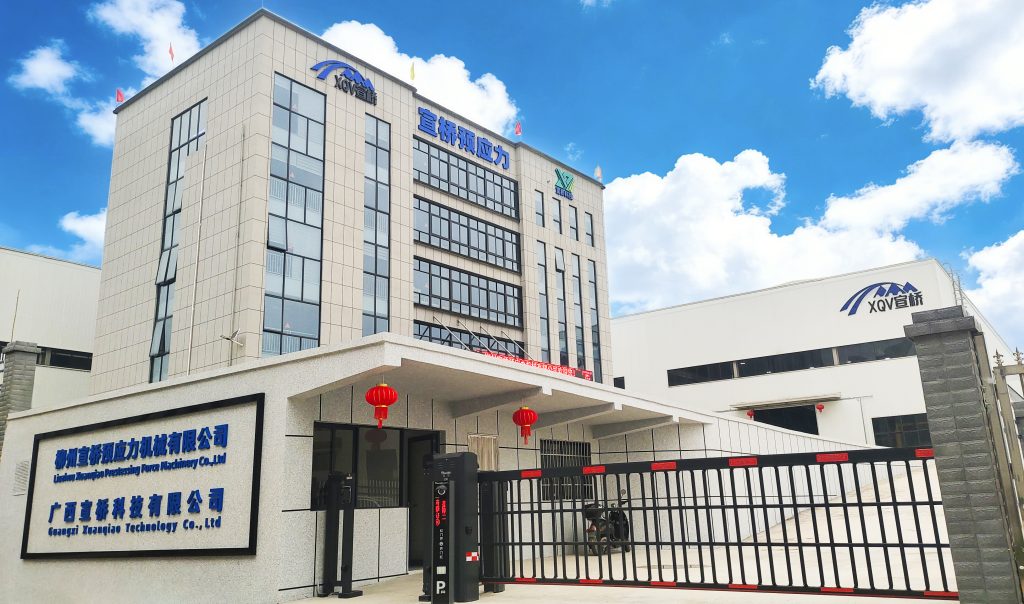
Liuzhou Xuanqiao Prestressing Force Machinery Co., Ltd.
Address:Block A-10-4, Hebiao Industrial Park, Yufeng District, Liuzhou City, Guangxi
Postal Code:545000
Customer service hotline:
+86 0772-2169908
Sales Department Phone :
+86 19101251623(Mr.Kong)
Technical Phone Number:
+86 18775155422 (Mr. Zhou)
whatsapp:+86 19101251623
Fax:+86 0772-2169908
email: info@lzxqv.com
Website:www.xqvglobal.com

Frequently Asked Questions
Quick answers to the most common questions about our prestressing equipment, product selection, installation, maintenance, and after-sales support. If you don’t find what you’re looking for, feel free to contact us directly.
It depends on the number of strands and the required tension force. Our YCWB series ranges from 100T to 300T (1000kN–3000kN). We also offer custom solutions for larger or smaller requirements.
Quick reference:
Quick reference:
- YCWB100 – 1000 kN (≈100T) | 200mm stroke | 70 kg
- YCWB200 – 2000 kN (≈200T) | 200mm stroke | 120 kg
- YCWB300 – 3000 kN (≈300T) | 200mm stroke | 180 kg
The YCWB series is our 4th generation lightweight design — smaller, lighter, and more durable than the YCW series. It offers better sealing performance, higher strength reliability, and lower maintenance costs while maintaining the same rated capacity.
In short: YCWB = upgraded, lighter, more cost-efficient over the long run.
In short: YCWB = upgraded, lighter, more cost-efficient over the long run.
Our standard stroke length is 200mm for all YCWB series models.
Custom stroke options are available upon request for specific project requirements. Please contact us with your specifications.
Custom stroke options are available upon request for specific project requirements. Please contact us with your specifications.
Our anchor wedges (夹片) are manufactured through a precision 10-step process to ensure reliable gripping performance and long-term durability under high tension loads.
Production process (step-by-step):
Production process (step-by-step):
- 1. Cold drawing – Wire rod is drawn to precise diameter, improving dimensional accuracy and surface finish.
- 2. Intermediate annealing – Heat treatment to relieve internal stress and restore ductility for further forming.
- 3. Pickling – Acid bath to remove surface oxides and scale, preparing for coating.
- 4. Phosphating – Phosphate coating applied to improve lubrication and corrosion resistance.
- 5. Saponification – Soap-based lubricant coating to reduce friction during cold heading and extend tool life.
- 6. Cutting – Wire is cut to precise blank length for the wedge.
- 7. Cold heading – The blank is cold-formed into the basic wedge shape at room temperature for high strength and precision.
-
8. Heat treatment (3-stage process) – Through-hardening to achieve the required hardness, strength, and wear resistance:
- • Carburizing – Surface carbon enrichment to increase case hardness and fatigue resistance while maintaining a tough core.
- • Quenching – Rapid cooling to lock in the hardened microstructure, achieving high surface hardness and wear resistance.
- • Tempering – Controlled reheating to relieve internal stress, adjust hardness/toughness balance, and reduce brittleness.
- 9. AOI (Automated Optical Inspection) – Machine vision inspection to detect surface defects and dimensional deviations automatically.
- 10. Packing – Final packaging with anti-rust protection, ready for shipment.
💡 Quality assurance: Every batch is traceable. Our AOI system ensures 100% inspection of critical dimensions and surface quality.
Our standard jacks are made of high-strength alloy steel — cost-effective, durable, and proven for heavy-duty site conditions.
We also offer aluminum alloy versions, which are significantly lighter (ideal for frequent handling or lifting-limited sites) but at a higher cost.
We can advise which option suits your project better based on your site conditions and budget.
We also offer aluminum alloy versions, which are significantly lighter (ideal for frequent handling or lifting-limited sites) but at a higher cost.
We can advise which option suits your project better based on your site conditions and budget.
Our products comply with multiple international and industry standards, including:
- GB/T14370‑2015 – Chinese national standard for prestressing anchors
- JT/T329‑2010 – China transport industry standard
- TB/T3193 – China railway industry standard
- ISO – International quality management standards
- CE – European conformity certification
- ASTM – American Society for Testing and Materials
- BS – British Standards
Yes. We provide factory test reports and material certificates with every shipment.
Third-party inspections are also welcome — we can arrange for SGS, BV, or other independent inspectors upon request.
Third-party inspections are also welcome — we can arrange for SGS, BV, or other independent inspectors upon request.
Our MOQ is 1 set for standard jacks and oil pumps.
For custom products or large-volume orders, please contact us for details — we can discuss flexible terms based on your project needs.
For custom products or large-volume orders, please contact us for details — we can discuss flexible terms based on your project needs.
Standard lead time: 15–20 days after order confirmation.
For large orders or custom specifications, lead time may vary — we will confirm at the time of order placement.
For large orders or custom specifications, lead time may vary — we will confirm at the time of order placement.
Yes. We supply spare parts including:
- Seals and O-rings
- Pistons and cylinders
- Clamp rings and wedges
Yes. Each jack comes with a detailed operation manual and installation guide.
We also provide technical support via video call (WhatsApp or Zoom) if needed — our team can walk you through setup, operation, and troubleshooting in real time.
We also provide technical support via video call (WhatsApp or Zoom) if needed — our team can walk you through setup, operation, and troubleshooting in real time.
Regular maintenance is recommended after every major use. Key maintenance points include:
- Checking oil seals for wear or leakage
- Cleaning the piston surface to prevent contamination
- Ensuring proper oil pressure and fluid levels
- Inspecting wedges and clamp rings for damage
Absolutely. We provide lifetime technical support by email, WhatsApp, or video call.
Our team is ready to assist with:
Our team is ready to assist with:
- Installation guidance
- Operational troubleshooting
- Maintenance advice
- Any questions that come up on site
We stand behind our products. If any quality issue occurs within the warranty period, we will provide:
- Replacement parts at no cost
- Technical solutions to resolve the issue
- Support to minimize project delays
Pre-tensioning (先张法) and post-tensioning (后张法) are the two main prestressing methods. Here’s how they compare:
Pre-tensioning (先张法):
Post-tensioning (后张法):
Pre-tensioning (先张法):
- Process: Tendons are tensioned before the concrete is cast. Concrete is poured around the stressed tendons, and after the concrete cures, the tendons are released — transferring the prestress to the concrete via bond.
- Best for: Precast concrete elements — beams, slabs, sleepers, and other factory-produced components.
- Advantages: High production efficiency, uniform quality, excellent bond between steel and concrete, lower equipment cost for mass production.
- Limitations: Requires long casting beds, not suitable for in-situ cast structures, limited to straight tendons.
Post-tensioning (后张法):
- Process: Tendons are tensioned after the concrete has been cast and cured. Steel strands are placed inside ducts, concrete is poured, and after curing, the strands are tensioned and anchored against the hardened concrete.
- Best for: Cast-in-situ structures — bridges, large-span buildings, box girders, curved or complex geometries.
- Advantages: No casting bed required, suitable for on-site construction, allows curved/draped tendon profiles, ideal for heavy and long-span structures.
- Limitations: Requires ducts, anchorages, and grouting; more equipment and labor-intensive; higher cost per unit.
✅ Quick rule of thumb:
- 🏭 Pre-tensioning → use for precast / factory production (beams, sleepers, small-to-medium components).
- 🌉 Post-tensioning → use for cast-in-situ / large and complex structures (bridges, long-span roofs, heavy loads).
- 🔧 Your YCWB series jack is typically used for post-tensioning applications.
Still have questions?
We’re here to help.
Contact Us
Liuzhou Xuanqiao Prestressing Force Machinery Co., Ltd.
Address:Block A-10-4, Hebiao Industrial Park, Yufeng District, Liuzhou City, Guangxi
Postal Code:545000
Customer service hotline:
+86 0772-2169908
Sales Department Phone :
+86 19101251623(Mr.Kong)
Technical Phone Number:
+86 18775155422 (Mr. Zhou)
whatsapp:+86 19101251623
Fax:+86 0772-2169908
email: info@lzxqv.com
Website:www.xqvglobal.com
